Failed lead flashings are one of the most common causes of roof leaks in Ipswich. Chimney soakers, step flashings, valley linings and parapet flashings all deteriorate with age. We carry out professional leadwork across Ipswich and Suffolk — correct code specification, properly dressed.
Tell us the job in 30 seconds. No pushy sales, no call-out fee.
📞 Call Now: 01473 807630Lead is the premium material for roof waterproofing junctions — chimney flashings, valley linings, parapet copings, flat roof upstands. When correctly specified and installed, lead outlasts the building. When underspecified, poorly dressed, or patched with sealant rather than replaced, it is one of the most common sources of roof leaks in Ipswich.
The Ipswich stock of Victorian and Edwardian properties carries a significant volume of lead that was installed 50–100+ years ago. Some of this original lead — correctly specified at the time — is still performing well. Other lead on the same properties has been repeatedly patched with bitumen sealant or lap seal over the decades, which is a short-term fix that delays the proper replacement and causes more damage in the process. We assess original lead honestly on survey and advise on whether it can be preserved or needs replacing.
Lead flashing failures on Ipswich properties fall into three categories: underspecified code (code 3 used where code 4 or 5 was needed, so it fatigues faster); incorrect dressing (lead not turned sufficiently into the mortar joint, or laid without expansion joints, so it splits along stress lines); and sealant over lead that should have been replaced (the sealant fails faster than new lead would have and causes more damage in the process).
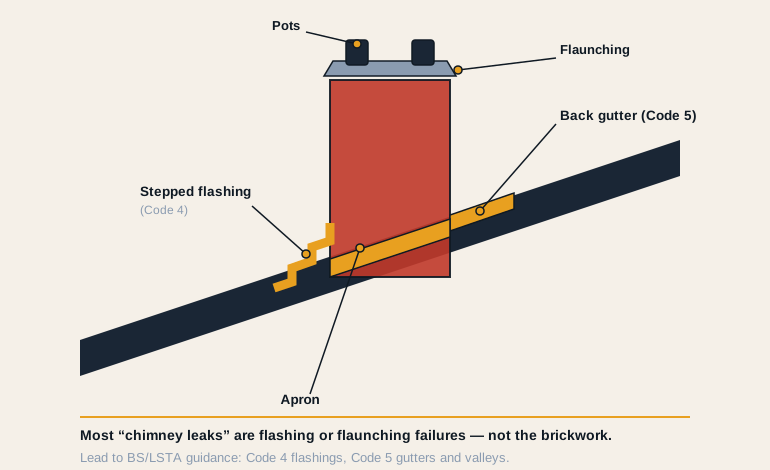
We use code 4 minimum on all chimney step flashings and soakers, code 5 on back gutters and valley linings. We dress to BS6915 standard, with expansion joints in all runs over 1.5 metres, and we never use sealant as a substitute for properly replaced lead.
Free quote — no call-out fee
📞 01473 807630Lead weatherproofs the junctions on a roof — valleys, chimney flashings, soakers and bay tops. Most persistent leaks on Ipswich's Victorian terraces trace to underspecified or fatigued lead at exactly these points.
When it is not the answer: If the surrounding covering has also failed, isolated leadwork won't solve it — the whole junction or slope may need addressing, and we'll be straight with you about scope. Read the full guide.
Most persistent leaks on Ipswich's older stock trace to the leadwork, not the tiles. The Victorian and Edwardian terraces off Norwich Road and around the California area have lead valleys shared between properties, lead flashings around the party-wall parapets, and lead soakers at every roof-to-wall junction — and when that lead is underspecified, fatigued, or patched over with sealant, water tracks straight into the roof. Proper code 4 or 5 lead, hand-dressed and patination-treated, lasts forty to eighty years; the sealant bodges a cowboy leaves behind rarely survive one Ipswich winter. On the bay-windowed terraces the bay-top lead is a frequent culprit, and getting the detail right at that junction is what stops the recurring damp above a bay.
We specify lead by code to the detail: code 4 for most flashings and soakers, code 5 where the exposure or the span demands it. The lead is hand-dressed to the profile of the tiles or slates and finished with patination oil so it weathers evenly and does not stain the covering or brickwork below. On the party-wall valleys shared between Ipswich terraces we fit proper lead-lined valleys rather than the cheaper alternatives, because these are the junctions that carry the most water and fail most visibly when they are underspecified. Correctly-dressed lead at a chimney is a full step-and-cover flashing with soakers under each tile course, not a single strip mortared into a chase — which is the shortcut that lets water track straight into the roof within a year or two.
In practice, the leadwork jobs we are called to in Ipswich cluster around the older housing: the party-wall valleys and parapet flashings of the Victorian terraces, the bay-window roofs that are so common on the Norwich Road and California streets, and the chimney flashings on the dense stack stock near Christchurch Park. Each needs a different lead detail done properly. A bay-top re-lead is a one-to-two day job; a chimney flashing renewal usually needs a day with tower or scaffold access at the stack; and a shared valley re-lead between two terraces has to be coordinated so both properties stay watertight while the work is done. We survey to find the true source of the leak first, because water at a ceiling often travels a surprising distance from where it actually enters.
We trace the leak to its true source and assess the lead code, dressing and joints at the junction.
A fixed price for the leadwork, specifying the correct lead code (4 or 5) for the detail.
Booked within a few days; leadwork at height is scheduled with the right access.
We strip the failed lead and hand-dress fresh code 4/5 lead, patination-treated to weather evenly and last decades.
Site cleared, guarantee handed over.
| Job | Typical duration |
|---|---|
| Soaker / flashing repair | Half a day |
| Chimney flashing renewal | 1 day |
| Valley re-lead | 1–2 days |
| Bay window roof re-lead | 1–2 days |
Leadwork fits in most weather; we avoid dressing lead in hard frost.
Leadwork at valleys and stacks usually needs a tower or scaffold for safe standing time at the junction. Scaffold is specified for: chimney flashings, valley re-leads, and anything at ridge height - always itemised in your written quote, never a hidden extra, and we arrange it.
Ipswich's Victorian terraces off Norwich Road are narrow-fronted with resident parking, so rear-access scaffold and permit-controlled pavement space are common; the post-war estates at Chantry and Whitehouse have open frontages where access is far simpler. Pavement scaffold and skip permits go through Ipswich Borough Council; allow a few working days on streets like Fonnereau Road, the terraces off Norwich Road, the California streets where space is tight.
| Job | Typical range | Notes |
|---|---|---|
| Soaker / flashing repair | £200 – £500 | Code 4/5 lead, hand-dressed |
| Chimney flashing renewal | £300 – £700 | Full step and cover flashing |
| Valley re-lead | £400 – £900 | Party-wall valleys on terraces |
| Bay window roof re-lead | £400 – £900 | Common on Victorian bays |
| Lead ridge / hip detail | per scope | Priced after survey |
Worked example: Re-leading a party-wall valley between two Victorian terraces off Fonnereau Road in code 5 lead, including tower access: about £560.
No deposit on leadwork under £500. Staged payments on larger work — nothing before materials are on site. VAT included.
Covering IP1, IP2, IP3, IP4, IP5 and surrounding postcodes.
Leadwork is covered for 10 years; correctly-specified and dressed lead should last 40–80 years.
If a fault appears in covered work, we come back and put it right. No quibbling, no re-charge.
Confined to the junction being worked on, low mess, and you don't need to be home for external leadwork. You do not need to stay home for external work - we just need power and access agreed in advance.
Carried out year-round; patination oil goes on to weather the fresh lead evenly and prevent staining. Ipswich sits exposed to easterly weather off the North Sea with little shelter, and the Gipping valley holds autumn damp that slows drying times.
"Lead valley replacement on our Victorian semi. Code 5 lead, properly dressed with expansion joints. They explained exactly what was wrong with the original (no expansion joints, had split from fatigue) and the fix made total sense. Excellent work."
"Chimney flashing replacement — soakers, step flashings and back gutter. They used the correct code throughout and the dressing was neat. No more leak above the bedroom window. Very professional."
"Lead parapet coping on our period property. They matched the original profile, correct code specified without being asked. The detail at the corners was excellent. Would not hesitate to recommend."
Chimney flashing replacement on a standard property in Ipswich typically costs £300–£700 depending on the number of soakers, step flashings and back gutter. Valley lining replacement costs £400–£900 per valley. Free survey, exact quote.
Code 4 lead for step flashings and soakers on most residential applications. Code 5 for back gutters, larger flat areas and valley linings. We specify correctly for each application — underspecified lead fails faster and causes more damage than the cost saving justifies.
Correctly specified and installed lead flashings last 40–80 years. Failed lead on Ipswich properties is usually the result of underspecified code, incorrect dressing technique, or sealant patching rather than proper replacement. We don't patch — if lead needs replacing, we replace it properly.
Thermal movement. Lead expands and contracts significantly with temperature change. If it was installed without proper joints or fixing clips to allow this movement, it cracks from fatigue — usually along the top edge or at corners. This is a technique failure, not a material failure. Correct installation prevents it.
Yes. For Victorian and Edwardian properties around Christchurch Park and central Ipswich, we dress lead to the original profile wherever possible. For listed buildings we advise on any consent requirements before starting.
Yes. Parapet copings, flat roof upstands and parapet wall flashings are regular work on Ipswich's older commercial and residential buildings. We survey carefully and specify the correct code and jointing for each application.
A soaker is the individual lead piece that sits under each tile at a roof-to-wall junction. When soakers are omitted or fail, water tracks under the tiles directly to the wall and eventually inside. We always fit individual soakers under each tile course — it's the correct method, not the shortcut.
No call-out fees. No obligation. Local Ipswich roofers who turn up when they say they will.
01473 807630 ✉ Email Us Instead