Claydon's 1970s–90s housing stock is producing regular ridge mortar failures as it ages. We cover Claydon, Great Blakenham, Barham and the Mid Suffolk corridor north of Ipswich.
Tell us the job in 30 seconds. No pushy sales, no call-out fee.
📞 Call Now: 01473 807630Claydon's housing — predominantly 1970s, 1980s and 1990s detached and semi-detached — is now well into the maintenance phase. Ridge mortar failure is the most common repair job, particularly on estates along Thornhill Road and Great Blakenham Road where the original bedding has dried and cracked after decades of freeze-thaw cycling.
The valley setting means damp conditions accelerate moss growth, which in turn accelerates mortar deterioration. Properties in Claydon typically need ridge attention earlier than equivalent properties on drier high ground.
Free survey · No call-out fee
📞 01473 807630"Ridge repoint and hip tile rebed on our 1979 semi. Good work, fair price, tidy. They spotted a cracked valley tile and replaced it while up there."
"Slate repairs on our older cottage. Good match, careful work. Efficient and reliable."
"Several tiles off after a gale. Repair exactly as quoted. Good service."
Most Ipswich roof problems show themselves in one of a few ways. If you recognise any of these, a repair is likely — and worth catching before a small fault soaks the timbers beneath.
When it is not the answer: If more than about a third of the covering has failed, or the fixings across a whole slope have corroded, repairing tile-by-tile is money wasted — a re-cover is the sound investment. Read the full guide.
The commonest Ipswich repair pattern follows the housing stock. On the Victorian terraces off Norwich Road and around the California area, leaks concentrate at the shared party-wall valleys and the lead flashings around parapets — points a pavement glance never sees. On the 1930s hipped semis in Rushmere St Andrew, it's the hip lines and the ageing sarking felt. And on the concrete-tile estates at Chantry, Whitehouse and Whitton, a slipped tile is usually the first visible sign that the fixing nails have started to corrode across the slope. Knowing which pattern applies to your roof is the difference between a lasting fix and a repeat visit — which is why our survey always includes the loft interior, not just the tiles you can see from the ground.
When we quote an Ipswich repair we always separate the access cost from the repair itself, because on the narrow terraced streets a scaffold tower and a skip permit through Ipswich Borough Council can be a real part of the bill on an otherwise small job. We work to NFRC standards, match tiles from reclaimed stock where the covering is no longer made, and use proper code 4 or 5 lead at any flashing — not the sealant patches that fail within a season. If the survey shows the fault is isolated, we fix it and leave it; if it shows the slope is failing, we tell you honestly that repeated repairs are money wasted and talk you through the re-roof numbers instead.
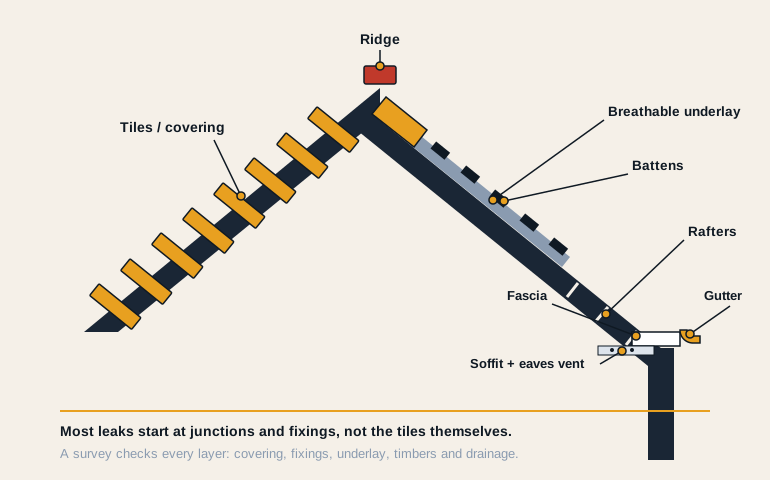
We inspect the covering, ridge, valleys, flashings and the loft interior to find the real cause — not just the visible symptom.
You get a fixed price for the specific repair, with access and materials separated out. No call-out fee, no obligation.
Non-urgent repairs are usually booked within a few days across Ipswich; active leaks are prioritised for make-safe.
We carry out the repair to NFRC standards, matching tiles and using proper code 4/5 lead where flashings are involved.
We clear all debris, leave the site tidy, and hand over the workmanship guarantee in writing.
| Job | Typical duration |
|---|---|
| Slipped or cracked tile refix | 1–2 hours |
| Lead flashing or soaker repair | Half a day |
| Rear valley rebuild | 2–3 days |
| Ridge or hip re-bedding (per run) | 1 day |
Wet or high-wind days pause tiling work — we build weather margin into every Ipswich booking.
Most Ipswich repairs run from roof ladders or a tower; scaffold is quoted only where the job needs safe standing time at height. Scaffold is specified for: chimney-side repairs, full valley rebuilds, and anything beyond a day at height - always itemised in your written quote, never a hidden extra, and we arrange it.
Claydon's 1970s–90s housing along the A14 corridor north of Ipswich is producing regular ridge and hip mortar failures as it ages, with concrete interlocking tile the dominant covering. Pavement scaffold and skip permits go through Mid Suffolk District Council; allow a few working days on streets like Church Lane, the Norwich Road frontage, Barham approach where space is tight.
| Job | Typical range | Notes |
|---|---|---|
| Slipped or cracked tile refix | £150 – £400 | Per visit; access-dependent |
| Lead valley or flashing repair | £300 – £700 | Proper code 4/5 lead, not sealant |
| Ridge or hip re-bedding (per run) | £350 – £650 | Dry ridge option costs a little more |
| Chimney stack repair | £200 – £800 | Scope-dependent; scaffold itemised |
| Emergency make-safe | £150 – £500 | Storm/leak; recoverable on insurance |
Worked example: A rear valley re-lead on a 1930s semi in Rushmere St Andrew, including tower access and waste: about £480, completed in a day.
No deposit on repairs under £500. Staged payments on larger work — nothing up front before materials are on site. VAT included in every written quote.
Covering IP6 and surrounding postcodes.
Workmanship on the repaired section is covered for 10 years in writing; any replacement tiles or lead carry manufacturer warranties on top.
If a fault appears in covered work, we come back and put it right. No quibbling, no re-charge.
A day of ladder work and a small amount of tile debris — we sheet below the work area on the terraced streets and clear everything before we leave. You do not need to stay home for external work - we just need power and access agreed in advance.
Repairs run year-round; temporary weatherproofing goes on the same day if rain stops play. Set on the higher ground above the Gipping, Claydon's roofs catch the wind funnelling down the valley corridor, which lifts poorly-bedded ridge tiles and dry-verge caps.
Most repairs cost £150–£450. Ridge repointing on a standard semi runs £300–£450. Free survey, exact quote.
Yes — Claydon, Great Blakenham, Barham, Henley, Coddenham and all IP6 villages.
The Gipping valley location means more damp and more moss — moss accelerates mortar failure. A biocide treatment at the same time as repairs significantly slows the cycle.
Re-bedding a standard semi ridge typically costs £300–£500. Free survey, exact quote.
No call-out fee on any job across Claydon and Suffolk. Free surveys, free quotes — you only pay once you have agreed the work in writing. Call 01473 807630 any time.
Yes. We carry £5m public liability insurance on all work in Claydon and the surrounding Suffolk area. We are also registered with the NFRC — details available on request before any job starts.
All our roofing work in Claydon carries a 10-year written workmanship guarantee. This covers the labour and installation — separate to any manufacturer guarantee on materials. We provide the guarantee document on completion of every job.
No call-out fees. No obligation. Local Ipswich roofers covering Claydon and all of Suffolk.
01473 807630 ✉ Email Us Instead